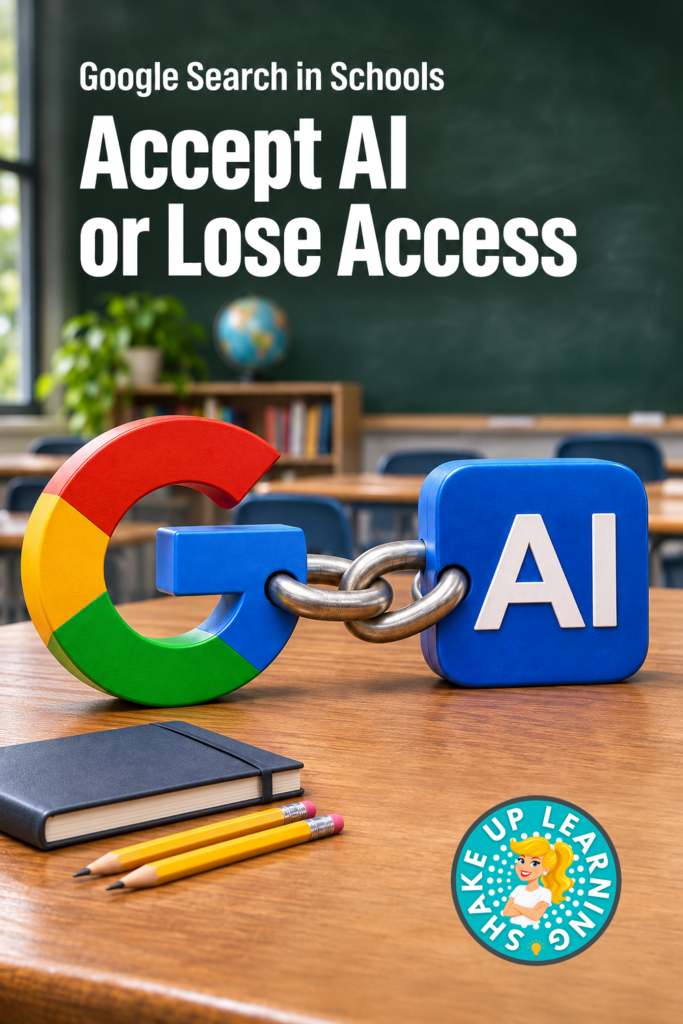
 Google Search in schools is changing. Can schools allow students to use it without also allowing its AI features? Under Google’s announced approach, that choice won’t be available for school-managed K–12 student accounts.
That creates a difficult decision for schools that want students to research online while limiting their use of generative AI.
The Associated Press reports that schools rejecting AI would also lose Google Search access for their managed student accounts.
Before changing lesson plans or sharing a warning with families, let’s unpack what Google announced, why people are concerned, and what still needs clarification.
*Related: How to Use Guided Learning in Google Classroom
What Is Changing for Google Search in Schools?
In its November 3 announcement, Google says access to Google Search, Gemini, Gemini Notebook, and Gemini in Classroom will be off for K–12 student accounts until school administrators explicitly enable them.
Google presents this as a way to give schools more control. The company says it will provide additional details before the changes roll out.
The important distinction is that Google Search already includes generative AI features. Turning Search on does not mean choosing traditional Search without AI.
These announced controls concern school-managed K–12 student accounts. They should not be described as an immediate block on every student’s personal account or every device.
Can Schools Keep Search and Turn Off Gemini?
Yes. Google clarified that administrators can disable Gemini while keeping Search available. However, the announced choices do not include an AI-free Search option, according to Ars Technica’s reporting and clarification from Google.
That leaves schools with a narrower choice than many families and educators want: allow Search with AI, or turn Search off for those student accounts.
Nothing in the announcement requires a paid AI subscription. The controversy centers on access and school control.

When Will This Happen?
There are two timelines to keep separate:
- Search Guided Learning pilot: Google says selected U.S. schools will begin testing it later in November, with expansion to follow.
- Broader control changes: Education Week reports that Google’s education leadership said the changes would begin in early 2027.
A complete implementation schedule has not yet been provided in Google’s announcement. Check your district’s official notices before assuming the change has reached your school.
What Is Search Guided Learning?
Google is building a version of Guided Learning into Search that is intended to help students work through certain homework questions with prompts and steps rather than immediately supplying answers.
Google cites its research on Guided Learning and says the Search pilot will gather educator feedback. Those findings and intentions should not be treated as proof of how every future Search interaction will work in a classroom.
This is also distinct from a teacher assigning a Guided Learning activity in Google Classroom.
Why Are Educators and Parents Concerned?
Schools Want Meaningful Choices
A district might support teachers using AI for planning while placing tighter limits on student use. It might also allow different tools at different grade levels.
Those decisions become harder when a familiar research tool and generative AI are packaged together.
AP reports criticism from child advocates and policymakers, including former FTC chair Lina Khan and Fairplay executive director Josh Golin, about Google’s influence over school technology decisions. Those are their criticisms, not findings that Google has violated a law. Read the AP report.
Finding an Answer Is Different From Demonstrating Understanding
Teachers need to know whether students can explain a concept, evaluate evidence, and apply what they learned.
In a July assessment of Google Search’s AI features, Common Sense Media’s Youth AI Safety Institute reported that AI Mode produced complete responses to all 180 homework assignments it tested.
The context matters: researchers tested standard Search on child and teen Family Link accounts between May 19 and July 1, 2026. They did not test the forthcoming school Search Guided Learning experience or measure long-term learning outcomes. Google said it had made changes addressing some prompts; the researchers had not independently verified those changes before publication.
The findings raise legitimate questions, but they do not establish how the new school mode will perform.
Research Skills Still Need Practice
Students need opportunities to locate information, compare sources, recognize unsupported claims, and explain why evidence is trustworthy.
Education Week highlights the tension: turning Search off can disrupt research activities, while leaving AI-enabled Search on raises questions about how much thinking students do themselves. Its reporting also notes that technical workarounds may place additional demands on districts with limited staffing.
A school policy needs to account for the actual student experience, not just whether an app is labeled “allowed.”
*Related: Top 20+ AI Tools for Teachers

Five Questions to Ask Your District
You don’t need to settle the entire AI debate to start a useful conversation.
- Which student accounts and grade levels will be affected? Ask for the district’s implementation plan rather than assuming every student will have the same settings.
- What will students actually see in Search? Request a demonstration using a district-approved student test account, including AI summaries, conversational responses, and Guided Learning where available.
- How will the district’s AI policy apply to Search? Teachers and students need clear guidance when an ordinary research task leads to an AI-generated response.
- What privacy and safety protections apply to each enabled feature? Ask the district’s technology and privacy team to review the applicable terms. Avoid assuming every Google service handles student information identically.
- What research resources will remain available? If access changes, teachers need a workable plan for library databases, curated sources, and other approved tools before assigning the next research project.
Keep the Learning Goal Visible
While districts evaluate the change, teachers can make the thinking behind an assignment more visible.
For a middle school science investigation, ask students to identify the original source behind a claim and explain whether its evidence supports their conclusion.
For a high school history assignment, have students compare two sources and explain how their perspectives differ.
A short conversation, annotated source, or explanation of a revised answer can reveal more than a polished final paragraph alone.
Schools deserve clear information about their options, and teachers need time to understand how those options affect learning. A product announcement should begin that conversation, not replace it.
What would your school need to know before making this decision?
Keep Learning With ALL ACCESS

Want practical support as you evaluate AI and Google tools for your classroom?
The ALL ACCESS Teacher Membership includes on-demand professional learning, the members-only AI Prompt Library, and downloadable cheat sheets, guides, and templates.
Explore the ALL ACCESS Teacher Membership
© Shake Up Learning 2025. Unauthorized use and/or duplication of this material without express and written permission from this blog’s author and/or owner is strictly prohibited. Excerpts and links may be used, provided that full and clear credit is given to Kasey Bell and Shake Up Learning with appropriate and specific direction to the original content on ShakeUpLearning.com. See: Copyright Policy.