 So, you’ve decided to homeschool.
Now comes the question that hit me pretty quickly:
Where do I even start?
Curriculum was the first thing that came to my mind. Math curriculum. Reading curriculum. Online programs. Workbooks. All-in-one programs. Secular curriculum. Faith-based curriculum. Programs designed for neurodivergent learners.
And once you start searching, there are approximately eleven billion options.
Okay, maybe not eleven billion. But it feels like it.
The more I started researching, the more I realized that choosing curriculum isn’t actually the first decision.
Before we decide what to buy, we need to know what we’re trying to build.
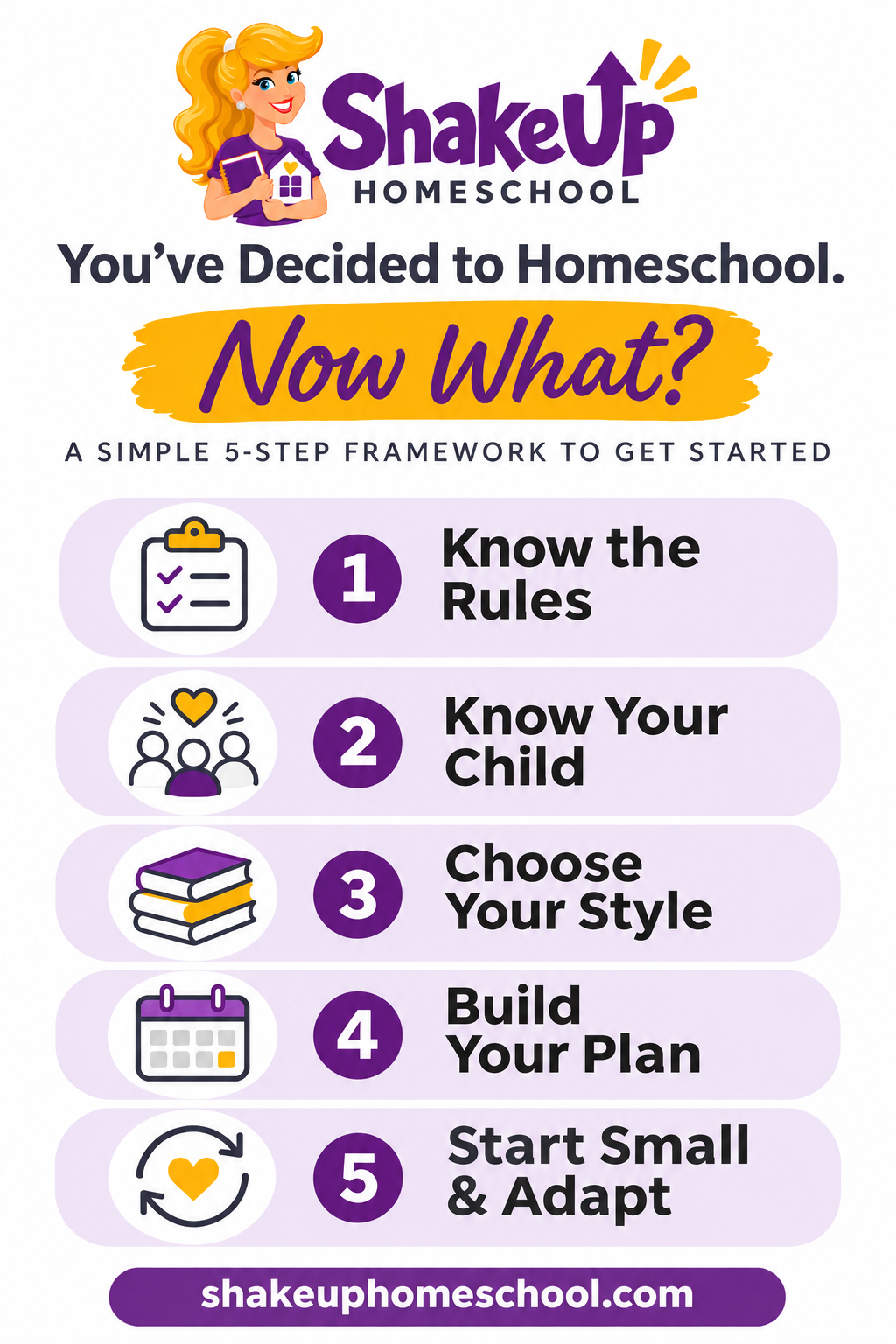
I’ve broken the process down into five decisions that make the whole thing feel much more manageable:
Know the Rules → Know Your Child → Choose Your Style → Build Your Plan → Start Small & Adapt
That’s it.
Let’s look at each one.
1. Know the Rules
Before you start shopping, find out what your state actually requires.
Homeschool laws vary by state. Depending on where you live, requirements may include notification, required subjects, attendance records, testing, evaluations, or other documentation.
I’m in Texas, where homeschool families have quite a bit of flexibility. But your state may be completely different.
Use HSLDA’s Homeschool Laws by State to look up your state’s requirements, then verify the details with your state education agency’s current homeschool guidance. Legal requirements are different from academic standards or curriculum choices your family may choose to use.
So before you worry about curriculum, planners, or what time school should start, answer:
What am I legally required to do?
That gives you the boundaries. Everything else can be designed inside them.
I’ll dig much deeper into this in the next post in this series.
2. Know Your Child
This is the part I think we can easily skip because we assume we already know our kids.
Of course we know them.
But now we’re looking at them through a different lens.
Think about:
- What are their strengths?
- Where are they struggling?
- What are they obsessed with right now?
- Do they like reading, talking, building, drawing, moving, watching, listening, or making?
- How long can they realistically focus?
- How independent are they?
- Are they at the same academic level in every subject?
- Are there sensory, attention, executive-function, communication, or motor needs to consider?
- Are they neurodivergent?
- Are they gifted or twice-exceptional?
- Do they have dyslexia, dysgraphia, ADHD, autism, anxiety, processing differences, or another learning need that affects how school works for them?
- Are there accommodations or supports that have helped in the past?
- Are there things that consistently create frustration, shutdown, boredom, or overload?
This matters because homeschooling gives us room to stop forcing a child into one standard mold.
A child may be advanced in one subject and need significant support in another.
A gifted child may need more depth and challenge without needing harder work in every subject.
A child with ADHD may understand the material perfectly but struggle with long lessons, too much writing, or too many transitions.
An autistic child may do better with predictable routines, clear expectations, fewer unnecessary demands, or learning connected to a strong interest.
A child with dyslexia may need a very specific approach to reading instruction, but that does not mean every part of their education needs to be remedial.
And a twice-exceptional child can be both highly capable and genuinely need support at the same time.
These are possibilities, not a checklist attached to a diagnosis. Children with the same diagnosis can need very different supports, including children with special needs.
That is one of the biggest reasons I’m drawn to homeschooling in the first place.
We can stop asking:
How do I make my child fit this program?
and start asking:
What does this child need in order to learn well?
That answer should influence the curriculum you choose, the format you use, the pace you set, the amount of work you assign, the support you provide, and even what success looks like.
You do not need to have every diagnosis or label figured out before you begin.
But you do need to pay attention to the child in front of you.
That is the information we use to design the homeschool.
3. Choose Your Style
Now we can start thinking about what homeschool will actually look like.
And this is where I think a lot of us discover that homeschooling does not have to mean recreating school at the kitchen table.
You have choices.
You might want:
- mostly online learning
- mostly books and paper
- a combination of both
- structured lessons
- hands-on projects
- interest-led learning
- traditional curriculum
- a more relaxed approach
- a co-op or hybrid program
- outside classes or tutors
- faith-based materials
- secular materials
- different approaches for different subjects
You don’t even have to choose one label and live by it.
You can mix things.
Maybe math is paper-based.
Science includes experiments, documentaries, books, and field trips.
Art happens at a co-op.
Reading comes from actual books instead of a boxed curriculum.
And maybe an online program handles something you don’t want to teach yourself.
The question isn’t:
What is the correct way to homeschool?
It’s:
What kind of learning environment makes sense for this child and this family?
4. Build Your Plan
Now we get to curriculum.
Finally.
Once you know the rules, your child, and the kind of homeschool you want, curriculum research gets much easier because you have something to compare the options against.
Instead of asking:
What’s the best math curriculum?
you can ask:
What math curriculum works well for a child who needs short lessons, likes visual examples, is ahead conceptually, and hates doing pages of repetitive problems?
That is a much better question.
When researching curriculum, look at actual samples whenever possible.
Watch flip-through videos.
Use free trials.
Take placement tests.
Ask other homeschool parents what they liked and disliked.
Look beyond the marketing page.
But curriculum is only part of the plan.
This is also where you decide:
- Do we want a co-op?
- Do we want a hybrid program or microschool?
- Are there subjects I want to outsource?
- Do we need tutors or outside classes?
- What activities are already on our calendar?
- Will we homeschool four days or five?
- Mornings or afternoons?
- Traditional school year or year-round?
- How will I keep track of progress?
- What does our actual family schedule allow?
Your homeschool plan has to fit your life, not just look good on paper.
5. Start Small & Adapt
This may be the most important step.
Start.
You are probably not going to design the perfect homeschool before the first day.
And you don’t need to.
You’re going to learn things once you begin.
That curriculum everyone raved about?
Your child might hate it.
The schedule you thought was perfect?
Tuesday afternoon activities may destroy it.
The subject you expected to be difficult?
Your child may finish it in ten minutes.
Something else may take three times as long as you expected.
That’s information.
One of the biggest advantages of homeschooling is that you can respond to what you learn.
So give yourself permission to change things.
Change the curriculum.
Move the schedule.
Shorten the lesson.
Add a co-op.
Drop an activity.
Try something online.
Go back to paper.
Slow down.
Move ahead.
The plan is allowed to change because your child is not a standardized product.
Start With These Five Decisions
If you’re staring at 47 open curriculum tabs and wondering what you’ve gotten yourself into, close a few of them.
Start here:
1. Know the Rules
What does your state require?
2. Know Your Child
Who are you actually designing this education for?
3. Choose Your Style
What kind of homeschool makes sense for your child and your family?
4. Build Your Plan
Choose curriculum, community, schedule, outside support, and a simple way to track progress.
5. Start Small & Adapt
Begin, pay attention, and change what isn’t working.
Over the next several posts, I’m going to work through each of these steps in much more detail as I build our own homeschool.
Because right now, I don’t need 500 more curriculum recommendations.
I need a process for making good decisions.
And I’m guessing I’m not the only one.
Build a Homeschool That Fits Your Child
Get practical ideas, tools, experiments, and resources for creating a more personalized education without turning homeschool into another full-time job.
© Shake Up Learning 2025. Unauthorized use and/or duplication of this material without express and written permission from this blog’s author and/or owner is strictly prohibited. Excerpts and links may be used, provided that full and clear credit is given to Kasey Bell and Shake Up Learning with appropriate and specific direction to the original content on ShakeUpLearning.com. See: Copyright Policy.